A production shooting in Oak Park can rent a standard portable toilet for as little as 100 dollars a day, or book a restroom trailer starting around 175 dollars a day for talent and crew who need something closer to base camp comfort. Most productions mix both.
Crew size and shoot length drive the count. A tight two-day commercial shoot with 15 people runs fine on one standard porta potty rental and a handwash station. A feature with 60 crew over three weeks needs a real plan, and OSHA 1926.51(c) sets the baseline: one toilet facility for 20 workers or fewer, then one toilet seat and one urinal per 40 workers as headcount climbs past that. Production managers in Oak Park usually round up, not down, because a line at the honeywagon during a lighting reset costs more than the rental. If the shoot includes background talent bussed in for a day, treat that day like an event and check how many porta potties do I need before you lock the order. Crews wanting something nicer than a standard unit for principal cast often step up to a deluxe flushable porta potty, and any set with a cast or crew member using a wheelchair needs an ADA unit under ADA Standards section 213.2, which requires at least one accessible unit in any cluster, never fewer than one. Pair that with a portable sink rental or two near catering, since production trucks rarely carry enough running water for a full crew washing up between setups.
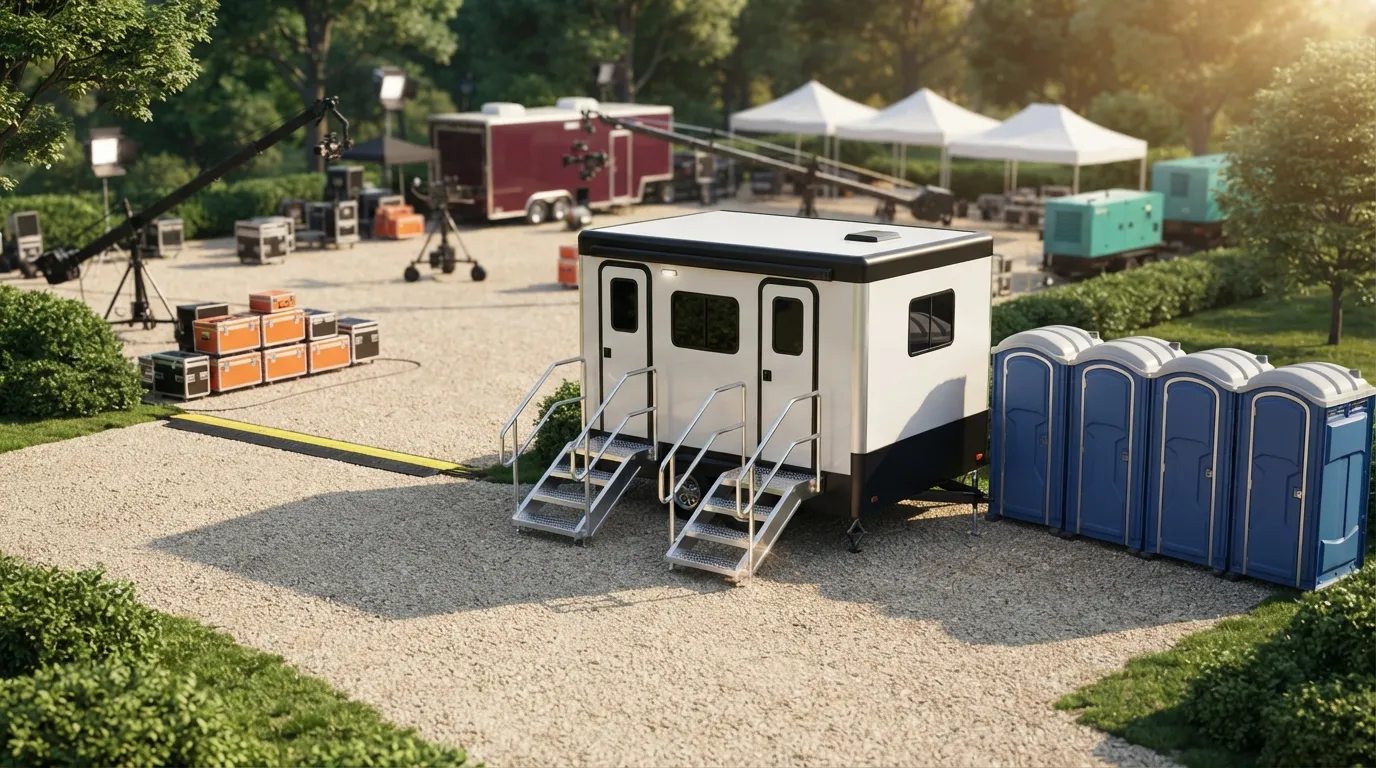
A restroom trailer is the standard for anything past two days with principal cast on location. Unlike a bank of standalone units, a trailer gives hair and makeup a private space to touch up between takes, and it holds up better against Oak Park weather than a row of open-air stalls. The 4 stall restroom trailer suits a mid-size crew, while bigger productions look at the 8 stall restroom trailer for base camp. Weekly trailer rental typically runs from 150 dollars up into the 1,600 range depending on trailer class, and a full production week is usually cheaper per day than booking single days back to back. If the trailer needs lighting or climate control run off generator power rather than a house tap, coordinate a portable generator rental film crews can plug straight into, and loop in a temporary power pole or light tower rental if the location has no power drop nearby. Ground crews should also plan delivery access: a roll-off or trailer delivery needs about 60 feet of straight clearance behind the truck, which matters on narrower Oak Park side streets near residential blocks. If the schedule is night exteriors, check porta potty in winter guidance for cold-weather units when shooting runs into late fall.
Placement on a public street, alley or right of way in Oak Park needs confirming with the city before delivery day, since location agreements and street-use permits vary by block and by production. Location managers should not assume a unit can sit on the parkway just because a similar shoot did it last year. Check porta potty permit requirements and porta potty placement guide early in prep, ideally the same week you lock the location, not the day before trucks arrive. If the shoot also brings in a dumpster for set strike or construction of a build, dumpster permit requirements follow a separate process and should get confirmed alongside restroom placement. Productions filming farther out, say in Maywood 3.4 miles west or Elmwood Park 4.0 miles northwest, should not assume Oak Park rules carry over; each town handles right-of-way placement on its own. For sets that also need fencing to hold back onlookers or secure equipment overnight, a temporary fence rental or crowd control barrier rental pairs naturally with the restroom order and can go on the same delivery run.
Handwashing counts as its own requirement separate from toilets. Under 29 CFR 1910.141(d)(2), washing facilities need actual soap and towels or a hand-drying device; hand sanitizer alone does not satisfy it. A handwashing station rental placed near craft services covers that cleanly, and if the shoot uses any paint, coatings or aerosol effects, OSHA 1926.51(f)(1) requires washing facilities specifically for that contaminant exposure. Review handwashing requirements with your location manager so nothing gets missed during tech scout.
Book as soon as the shoot dates and crew count are locked, ideally two to three weeks out for multi-day shoots. Restroom trailers move fast during festival season and busy production months. Same-week bookings are possible; check emergency porta potty rental if a schedule shifts last minute.
Yes. Weekend trailer rates run higher per day than a full week booking but cover short shoots without a weekly commitment. A two-day commercial or music video shoot is a common weekend booking; see restroom trailer rental cost for how weekend, weekly and monthly rates compare.
Most trailers include running water, interior lighting and climate control, though power source depends on the location. Confirm whether the unit needs a generator, a house hookup, or a temporary power pole run from the nearest panel before delivery day.
Yes, the requirement is not limited to cast. ADA Standards section 213.2 applies to any cluster of single-user units on set, crew or cast, and requires at least one accessible unit regardless of who specifically needs it that day.
Often yes, but placement in the right of way needs confirming with the city first. Location agreements typically address curb use separately from the restroom order itself, so confirm both before trucks are scheduled.
Yes. Oak Park Porta Pros delivers film set restroom rental across Oak Park and the surrounding metro, with same-day and next-day drop-off available on most orders.
Pricing depends on the unit and how long you need it. See our cost breakdown and request a free quote for an exact figure.
Standard rentals include scheduled service — a pump-out, a clean, a restock and fresh deodorizer. Busy or hot-weather sites can be serviced more often.
Call now or request a free quote — clean units, on-time delivery, transparent pricing.